Sliding shutters for patio doors, bifolds and wide openings
Tracked Shutters In Kent
Tracked shutters are an engineering problem before they’re a finishing problem. Hinged shutters work because each panel is supported on its hinge edge by the frame; the load path is straightforward. Tracked shutters carry the entire panel weight on a single horizontal track at the head, with the panels sliding along it. Get the engineering right and the panels glide silently for decades. Get it wrong and they sag, stick or rub from week one. We approach tracked installs with the engineering questions answered first.
Book a home visit
EXCELLENT Based on 96 reviews
 Posted on Google
 M J Choudhry OBEI am happy that I got InTouch with VIP shutter co. Everything was done professionally from start to finish. M J Choudhry OBE.Posted on Google
 Sharon NashJust had an awning fitted by VIP Shutters. Superb quality and customer service from start to finish. Highly recommended.Posted on Google
 Kelly HarringtonBarry and Alex come and fitted my shutters, no mess at all, you would never of known they had been. My curtain poles were close to the shutters, so I was unable to open my shutters fully. After a day I had decided a wanted my curtain pole moved. Messaged Barry and they were moved in a few day, again without any problems. I am now hoping to have the thermal blinds at the back of my house. Would never use any one else and HIGHLY recommend these guy. 5 star service, from start to finish.Posted on Google
 Trevor SpickettA big thank you to Barry for a very professional first class job .your attention to detail and Finnish are exceptional thank youPosted on Google
 Paul RobertsBarry and his company did a great job. We are really pleased with the shutters, the workmanship and quality of the service all mixed in. Would defiantly recommend.Posted on Google
 Danielle GregoryGreat service from start to finish. Professional and friendly. Resonably priced and the shutter looks lovely. Highly recommended.Posted on Google
 Danny ColeCannot recommend Barry and the VIP shutter Co enough. Great communication from the start accompanied by a very reasonable price. On the installation day there was no mess and everything fitted perfectly. Would 100% recommend and will be using again for 3 more windows at the rear of our property.Posted on Google
 Taiwo OkunadeHave a had a lovely experience with Barry, his such a nice man and professional in what his doing. His an experienced man I recommend him 💯.Posted on Google
 Lily RoseWe’re so thrilled with the installation and look of our new shutters. Barry and the team were excellent start to finish and no mess was left! Would highly recommend. SarahPosted on Google
 zuey89Really pleased with my shutters, they look great and the whole process was smooth and efficient. Would definitely recommend. Thanks to Barry.
First measurement we take at every tracked survey
The Head Depth That Decides Everything
Before we discuss panel design, finish, or any of the visible aspects of a tracked install, we measure the head depth. This is the vertical space available between the top of the door opening (or window opening) and any obstruction above – typically a soffit, a curtain rail mount, a bulkhead or the ceiling itself.
Standard tracked systems need 100-120mm of head depth. The track itself is around 50-60mm tall, the carriages that hold the panels add another 20-30mm, and we need clearance for the panel to clear the head when sliding – hence the total. If you have less than 100mm of head depth, we have alternative low-profile track systems but the panel options become more limited.
This is the question that determines whether tracked shutters are even possible at your opening. Cheaper installers sometimes try to fit a tracked system with insufficient head depth – the result is panels that scrape against the head when sliding, or systems that fail prematurely because the carriages are forced to operate beyond their tolerance. We don’t proceed if the head depth isn’t right.
Why we look behind the plasterwork
Lintel Checks And Load
Tracked panels are heavy. A four-panel run for a 4-metre patio door can weigh 40-50kg total. That weight hangs from a single point – the track fixed to the head – and the head needs to carry it cleanly without flexing or pulling away.
On most modern bifold and patio door installations, the lintel above the door is a steel beam (an RSJ) capable of taking the load without question. On older properties or non-standard openings, the structure can be timber or even just brick – which can sag or shed mortar under sustained load.
We check the lintel material at survey by tapping along the head with a small hammer (sounds amateur, gives a quick answer about whether the material is steel, timber or hollow), and where doubt remains, by drilling a small exploratory hole behind the planned track location. If the lintel can’t take the load directly, we either fix into adjacent solid material with extension brackets, or recommend reinforcement before installation.
Skipping this check is the single most common cause of tracked shutter failures we see when we’re called in to fix someone else’s install. The track sags after a few months of use, the panels start rubbing the floor, and the only fix is removing the entire system and reinstalling onto proper structural support.
The hardware that determines daily use
How The Panels Glide
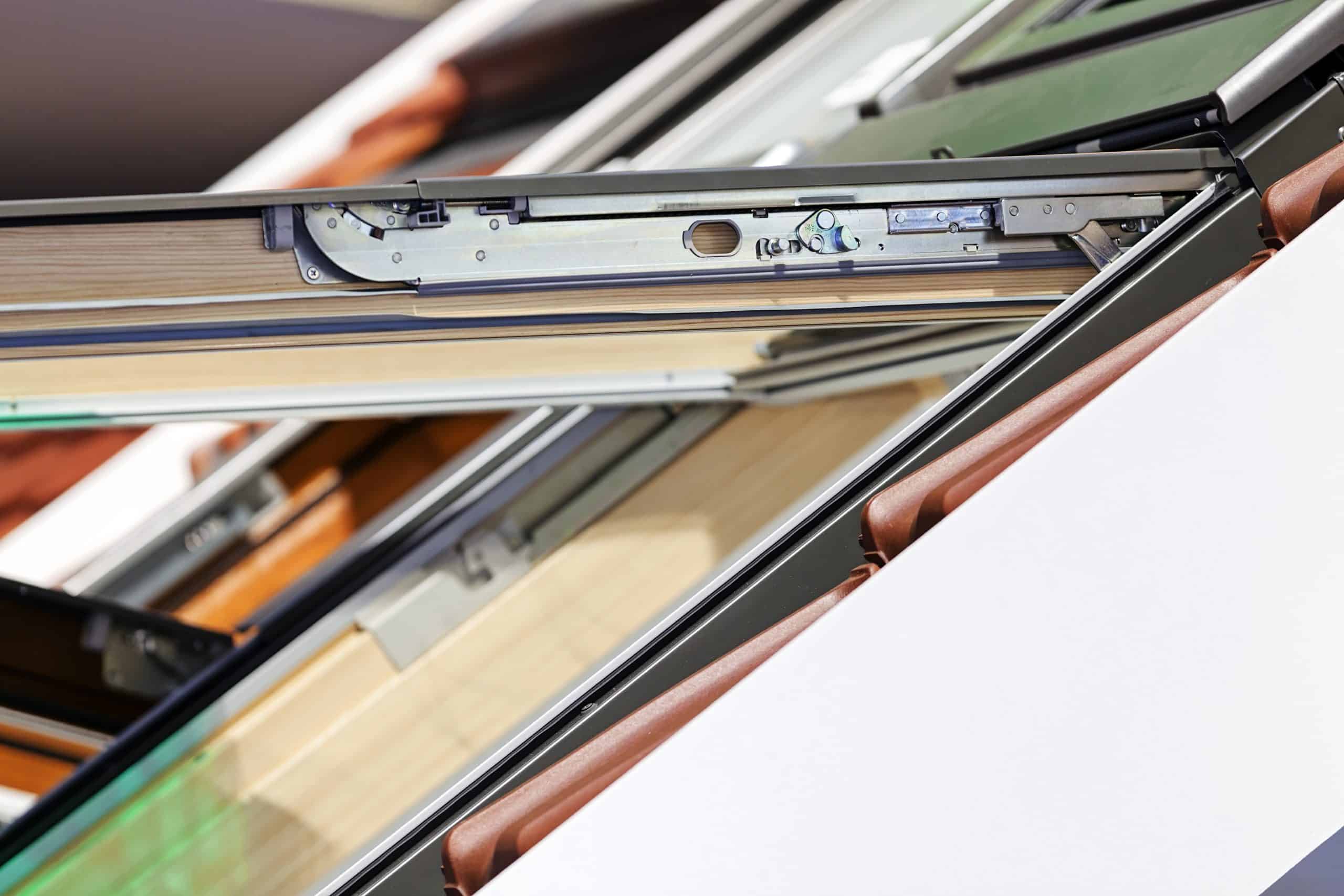
Track quality is the difference between one-finger smooth operation and two-handed effort. Quality tracks use precision-machined aluminium with self-cleaning runners and ball-bearing carriages. Cheap tracks use extruded aluminium with friction carriages – they work briefly, then dust accumulates, and operation degrades over weeks.
We use heavy-duty track systems as standard on our tracked installations. The hardware spec is one of the things that justifies the price difference between our installs and budget alternatives. The functional difference is immediately visible: lift the panel slightly to engage the carriage, push gently with one finger, panel glides silently end-to-end. No scrape, no judder, no resistance.
Carriage spacing matters too. Standard tracked panels have one carriage at each end of the panel head (so two per panel). For wider or heavier panels we add a third carriage in the middle. This distributes the load and prevents the panel from twisting under its own weight – a common failure mode on cheap installs after a few years.
More engineering than finishing
How a Tracked Shutter Install Actually Runs
Tracked shutter projects start with engineering questions and only get to the finishing questions if the engineering is right. The workflow reflects this with a more rigorous survey and a more careful install than other shutter formats.
Engineering-led survey
We measure the head depth (whether 100-120mm clearance is available above the door for the track and head box). We tap-test the lintel material to confirm whether it’s steel beam, timber bressummer or hollow brick. We measure the run width and confirm the panel count needed. The survey can take 30-45 minutes – longer than typical shutter surveys for good reason.
Manufacture with precision-machined track
Tracked installs use heavyweight track, ball-bearing carriages, and precision-cut panels. Lead times are typically 6-8 weeks – longer than hinged shutters because the track and carriage hardware is built to order and the panel sizing is exacting.
Levelling-critical install
Track positioned and levelled across the full run with a long spirit level (not a short one). Panels hung one at a time, slide tested, friction tuned. Most installs are completed in 4-6 hours for a typical patio door installation.
Four things cheap installs get wrong
Why Tracked Installs Need a Carpenter
Tracked shutter installations are technically demanding and the install detail is the primary determinant of long-term success. Cheap installs typically fail in one of four ways – we engineer around each.
Track levelled across the full run. A 4-metre track sloping by 2mm causes panels to drift to one end on their own. We level using a long spirit level, not a short one, and we shim the fixings if the lintel itself isn’t perfectly level.
Lintel material assessed before quoting. We don’t quote a tracked install until we’ve confirmed the lintel can take the panel weight. If the lintel is timber and tired, we’ll specify reinforcement before installation; if it’s adequate, we proceed with confidence.
Heavyweight track hardware as standard. Cheap track systems wear quickly and operate noisily within a year. Quality track with sealed ball-bearing carriages glides smoothly for decades. The cost difference is meaningful but the longevity is dramatically different.
Single-visit install for typical runs. Most tracked installations are completed in a single visit, even for 4-metre patio door runs. Cheap installs sometimes return for adjustments because the panels don’t operate cleanly first time – we calibrate at install, not after.
OUR PRODUCTS
Our Complete Window Covering Offering
If you are searching for the finest kent shutters, The VIP Shutter Co offers a complete range of made to measure plantation shutters that combine architectural elegance with proven, measurable performance. Independent testing has shown that a well fitted shutter can reduce heat loss through a window by up to 52 per cent, which is why so many homeowners now regard them as an energy efficient upgrade as well as a design choice.
Every shutter is cut to your precise sizes and finished to the colour, stain, or bespoke RAL shade of your choosing. We offer six classic styles, each available in sustainably sourced hardwood, engineered MDF, and waterproof ABS, with louvre sizes of 47 mm, 63 mm, 76 mm, and 89 mm, and either central or discreet hidden tilt.
Carpenter-led, Kent based
Why Choose The VIP Shutter Co
Choosing a made to measure window treatment is a long term investment, and the company you trust to deliver it matters just as much as the product itself. Here is why Kent homeowners, from period townhouses in Rochester to coastal properties in Folkestone, continue to choose The VIP Shutter Co year after year.
Expertise and experience
Barry, our founder, is a qualified carpenter with more than 25 years on the tools and over 20 years in the shutters and blinds industry.
Real benefits, not marketing claims
Every blind is made to measure, child-safe as standard, and fitted by us, not subcontracted out. Quality is checked at the workshop and again at the install.
Customisation
Choose from hundreds of fabrics, prints and finishes. Motorisation, blackout linings and child-safety features are options on most ranges.
Suitability across Kent homes
Bedroom blinds are one of the most-requested categories we fit in Kent, especially for young families upgrading from rental fittings. Over 100 Kent homeowners have rated us five stars.
Tracked specifics
Frequently Asked Questions
Up to about 6 metres in a single track on standard residential installations. Wider runs are possible with double tracks or split runs. We assess the lintel and head depth at survey to confirm the specific limits for your opening.
Most patio doors and bifolds, yes. The constraint is the head depth above the door – we need at least 100-120mm of clearance to fit the track and the head box. We check at survey.
Inside – they slide along the track inside the room and stack at one or both ends when fully open. The track is fitted to the inside face of the head, so the panels don’t project into the doorway.
On a properly installed quality track, you can move the panels with one finger. Rough or sticky operation usually means the track isn’t level or the lintel can’t take the panel weight – both fixable but worth checking before you sign off the install.
The VIP Shutter Co